Categories
Blog

San Antonio Rodeo & Livestock International Wine Competition

San Antonio Rodeo & Livestock International Wine Competition

A LOOK BEHIND THE CURTAIN BY A WINE JUDGE

Andre Boada | Judge & Sommelier | 10/5/20 – 10/7/20

We have all seen accolades posted on websites or even grocery/retail shelf talkers outlining a “Double Gold” International wine medal winner but how is that mark defined? In a quest to share insights I decided to parley my skillset by participating as judge in one of the top 10 wine competitions held within the US, San Antonio Rodeo & Livestock International Wine 2020 Competition. A three-day expose’ with two days of preliminary judging and one day for final champion awards.

It all begins by being selected as a judge. In my case, it occurred by happenstance. as I was involved by entering wines for Augusta Vin Estate Winery, based in Fredericksburg, TX. During the process I inquired about being a judge & sent in my credentials. Luckily for me I have a long history in the wine industry that includes judging in SF International mixed with a Court of Master Sommelier “Advanced” certification. Quite honestly, you never know if you’ll make the cut since all judges are highly qualified. Shortly after, I was selected as one of 50 judges with over 1000 wines entered within the competition.

Day 1
As you might imagine COVID conditions played into judging protocol and precheck involved a health screening questionnaire followed by temperature check and mandatory wearing a mask unless tasting wines. Upon arrival you get a name badge followed by a mystery/lottery table assignment. That way no one can predetermine tasting flights selected for your group. Each group of judges, all (5) five w/one captain who tallies the score. The group is individually spaced 6 feet apart and given tight instructions on scoring. Points are assigned for appearance, aroma, body, taste and finish.

All wines are tasted blind and your score is solely determined by what you decide.

Following the completion of each flight some judge discussion takes place based on favorites and/or if wine might need a second consideration to raise/lower score.
Judging began promptly at 10 AM and other than a quick 30 minute lunch, it was a fast and furious dance on your taste buds all through till 5 PM.

The highlights of the day: Sangiovesse – Texas $17-$39, amazing quality across the board. The other, Red Blends, Texas – French Blends and noticed mostly Rhone varietals as a focus. Lastly, the best flight, Cabernet Sauvignon $26-$30 – all were exceptional.
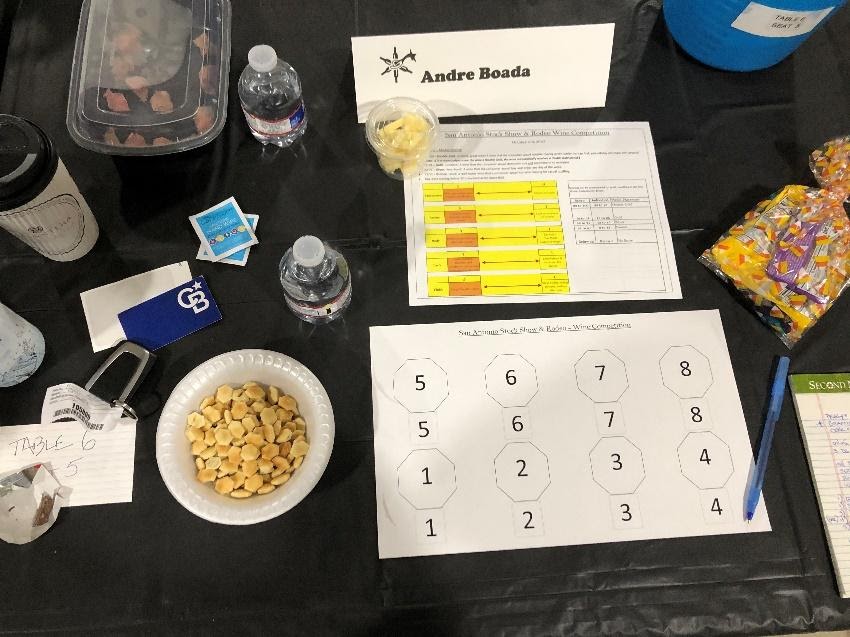
Setup at the judge seat - San Antonio Rodeo 2020 | VinoCadre
Set up at the judge seat- water, crackers, cold cuts, cheese and even some sweets.

The flight lineup, 12 in all for the day, consists of 7 pre-lunch and 5 post lunch. Each flight offers a grape or blend category and price point showcasing 6-8 wines. That said, you evaluate around 90 wines per day, sometime trying each wine 2-3 times. This in itself is challenging on the palette so taste then spit is needed. Also the rodeo provided ample ways for you to help your taste buds bounce back after each flight.
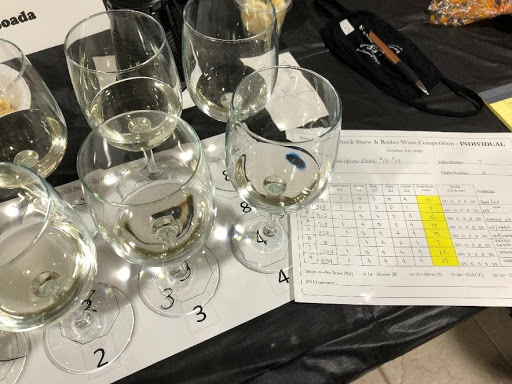
Sauvignon Blanc Flight with scores - San Antonio Rodeo 2020 | VinoCadre
Sauvignon Blanc Flight with scores

Day 2

Mainly a repeat of day one but with different wines and a new group of judges. There were just a few returning judges that included myself. At my table today, a savvy group including Will Bliss, senior wine buyer HEB, Jerkel Van Bibber, senior manager RDC, Jennifer Beckmann, GM/sommelier Slate Mill Winery and Lorelei Helmke, Press/sommelier. If you ever watched the movie “Somm” then you would appreciate this: Most unusual sommelier descriptors of the day, (1) this sangiovese smells like hot dog water and (2) color descriptor, Mega-purple.

What I really noticed today, a continuation of the seamless execution from all the volunteers. The sheer rotation of wines every 30 minutes was amazing. Each group of 5 judges had 5 volunteers making sure everything was on point. Really enjoyed meeting the dream team behind the scenes and honestly felt they enjoyed watching us judge.
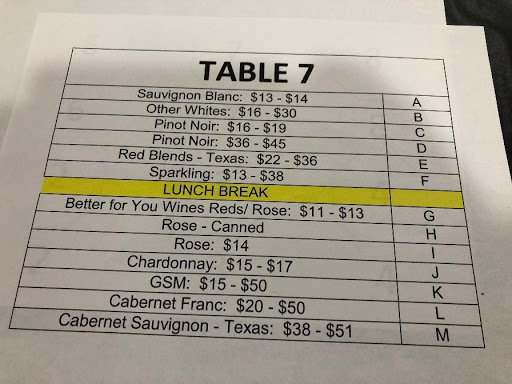
Agenda for the day 1 – each judge table had a different plan - San Antonio Rodeo 2020 | VinoCadre
Agenda for the day 1 – each judge table had a different plan

Added notes on the point system per wine, per judge
Appearance 0-1 points
Aroma 1-5 points
Body 1-7 points
Taste 1-7 points
Finish 1-5 points
Five judges per group so a 100 point scale was used
92-100 points Double Gold
72-91 Gold
52-71 Silver
32-51 Bronze

32-51 Bronze

If we noticed a flaw, for example a corked wine, then the wine would be replaced with a fresh bottle before judging. This occurred 3 times in two days.

In closing, I can’t thank the entire San Antonio Rodeo team enough for all the kindness they showed during the judging. Not only did they prefect the art of judging they made us feel safe, well respected and made me a sincere fan for all their efforts. Kudos to all for a job well done at every level and all the new friends that came into my circle of life.
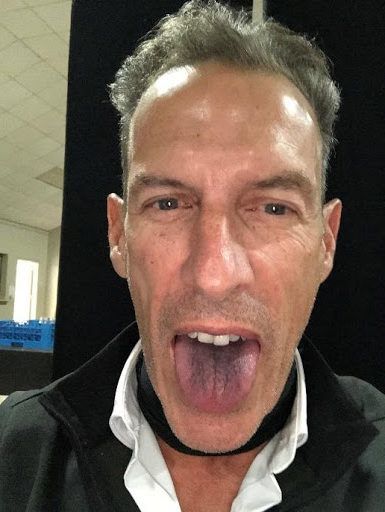
Andre Boada, sommelier tongue check at the end of day 2 - San Antonio Rodeo 2020 | VinoCadre
Andre Boada, sommelier tongue check at the end of day 2

Be sure to follow VinoCadre on social media for daily insights and antics as I explore the world of food & wine. I also plan to post final results from the competition once completed.

Categories
Blog

Corks & Cans hosted by David Elder TV host, San Antonio

Corks & Cans hosted by David Elder TV host, San Antonio

Virtual Wine & Beer Club.

Categories
Blog

Pivoting around COVID-19

Pivoting around COVID-19

Texas Hill Country Wineries retool, readjust, take care of one another

The wrath of COVID-19 has unleashed havoc around the world, sending new warning terminology like “Flatten the Curve,” “Social Distancing,” “New Mandatory Orders” and most recently, “It’s Your Responsibility.” It also created high unemployment, stock market declines mixed with furloughs (unpaid leave with guaranteed jobs at a later date). It’s a daunting scenario on the macro level, yet here in Texas Wine Country leaders in the winery arena have taken steps to pivot through the fire.

Through the COVID-19 turmoil we need to remember Texas stands proud, boasting one of the oldest wine-growing regions in the U.S. with vines planted more than a hundred years before even California and Virginia. Starting in the 1650s, Franciscan priests planted mission vines near El Paso. We even had horticulturist Thomas Munson use Texas vines, providing significant research and securing much-needed rootstock immune to the Phylloxera epidemic, and saving the French wine industry from total ruin. Sadly, Prohibition in the U.S. virtually eliminated the Texas wine industry until a revival in the 1970s bringing winery and new tourism life back to the state.


Here in Texas Hill Country we have over 60 wineries with many new winery permits pending. These attract millions of visitors from around the nation and bring much-needed revenue to the area. Yet with the pandemic shutdown, creative operational solutions were needed to keep Texas Hill Country wineries afloat.

Brian Heath, proprietor of the iconic Grape Creek Vineyards and Heath Sparkling Wines, made his 110 employees top priority, creating IT solutions to work remotely where possible and maintaining payroll, tips and bonus programs. All this was done even in advance of securing a PPP government loan. He even offered high-risk employees extra time off before returning to work.
Secondly his team crafted a sale’s rechannel initiative, pushing tasting room sales to online by offering a rare 25% discount. With his wine club, they made outbound calls assuring members with financial hardships, allowing a skip shipment option never used previously, and actually saw an increase over normal retention levels. Before reopening, he redesigned customer flow and seating to ensure safety standards and improve employee morale.

“It’s like the old saying, Let’s make sweet lemonade out of sour lemons. I was worried we would have high wine club attrition, yet our members supported our efforts online during the shutdown, which is a positive loyalty sign,” Heath said. “On the flip side, operating costs have gone up during the reopening phase mainly due to safety standards. A good example, five times more use of paper towels alone.”

Scott Felder, CEO of Augusta Vin Estate, an artisan, 100%-Texas winery with estate focus, also had employees’ jobs as a top priority. Using PPP funds, he crossed-trained tasting room personnel to work in his 60-acre estate vineyards, thereby increasing the educational tasting experience offered within his modern, spacious timber oaks tasting room. His sommelier team also developed a new education platform and email campaign that lifted online sales and now carries over into the reopening tasting experience.
“Like most, the winery and hospitality industries have had to navigate difficult unchartered waters with the coronavirus lock down. The federal Paycheck Protection Program (a part of the CARES Act) were a big help in allowing many to maintain payroll to their employees,” Felder said. “We at Augusta Vin had only six months of operations since our grand opening in early September of 2019 when the mandated closures occurred, but we decided early on to keep all of our staff on the payroll through the period.
“We utilized non-production employees to help in the vineyard-production facility during the two months of closure. Wineries had to continue with all vineyard and production operations in spite of the lack of revenue and that makes it especially difficult,” he added. “We are thankful to be welcoming business back to a safe Augusta Vin environment during the last month, and find that people are loving new, refound visits to Texas Hill Country. Since most Texas residents will not be flying to vacation destinations this year, the wine country in Central Texas is proving to be a great option for a beautiful get away that is close by car.”

Another winery leader in the Texas Hill Country, William Chris Winery flexed its marketing muscle by creatively formatting a compelling series of virtual tastings to offset closure sales. They were the first winery to close coupled with a delayed opening to ensure safety standards for employees and guests visiting the tasting room.

“Our values at William Chris take hold in good times and bad. In times of need we come together as one,” co-owner Chris Brundrett said. “We started tracking the COVID-19 one month in advance and reallocated one million dollars to protect the interests of our employees, the 28 families that grow our grapes and treat the public like family. We felt it was important to understand the true meaning of health by helping all, mentally and financially. That included calling wine club members personally, crafting a private label red blend (Wonderer Relief Project) and raising $45,000 for workers in the service industry.
“Bottom line is we had to work twice as hard to make half as much, but we prevailed supporting all that believed in that value,” Brundrett said.

Texas Wineries have a blessed character and believe this Abraham Lincoln quote reflects that sincerity: “Character is like a tree and reputation is like a shadow. The shadow is what we think of it: the tree is the real thing.”
One thing for certain, the COVID-19 Texas winery pivoting journey has pushed many to help one another. It has kept winery workers employed, consumers safe and the virus spread in check. That’s a monumental tree.

Categories
Blog

Finding A Balance

Finding A Balance

The movement to establish ‘100% Texas’ wines

The journey of Texas wines and legal requirements are constantly afoot looking for avenues to increase quality and recognition next to the wine-producing leaders of the world. Overall, there seems to be a ubiquitous vintner goal to build true Texas wine essence but surrounded by mixed emotions of how to achieve that practice.

The enormous question at hand: Are we at a tipping point to find that determination among vintners and grape growers or just remain status quo with federal guidelines?

Being a sommelier, I explored different Texas vintner viewpoints to help consumers understand the gravity at stake. My rationale, find a balance within the various winemaking and label standards, yet create wines that offer sense of place. The French call this simply “Terrior,” thus wine crafted with authenticity for consumers.

Let’s first look at federal requirements. Currently, Texas and 45 other states require 75% of grapes to be grown within the state listed on the label. While other well-known wine growing regions adhere to higher state-level appellation wines of 100%. They include California, Oregon and even France. Some would argue that using 100% grapes grown instate would build a Texas taste profile that defines the true essence behind Texas viniculture. Others maintain, the Texas grape growing landscape isn’t capable to support 100% Texas. Current Texas acreage under vine is growing yearly but still under 10,000 acres, a far cry from California with over 600,000 acres. Texas, due to under development, buys excess bulk wine often finding a home as blends for the 75% Texas wines. This excess California bulk wine is below current Texas contracts being offered and further counters a foundation to be 100% Texas.

Jeff Cope, founder of Texas Wine Lovers and long-term advocate of Texas wines, has this mindset. “While requiring a wine to have 100% Texas grapes in order to carry the Texas appellation on the label is a desirable goal, I believe Texas is still too young with the quantity of Texas vineyards and grapes available in order to achieve that,” Cope said.

Next, let’s explore a more defined Texas arena: Wines listed as sub-regions of the state reflecting appellation (AVA) status, such as the “Texas Hill Country” or “Texas High Plains” (85% grape requirement from a defined AVA). Once again, a disconnect as neither the federal Tax and Trade Bureau or state’s Texas Alcoholic Beverage Commission require the origin of the balance. The only alternatives are “Vineyard Designated” or “Estate” classifications maintaining 100% Texas fruit.
To the consumer, this 75%, 85% and even 100% bandwidth is confusing. Yet to further complicate the balance equation the Texas Legislature introduced an aggressive House Bill 4233, the “100% Texas” Labeling Bill. That proposed, five-year transition bill ultimately died in a 2019 committee review amidst contrasting viewpoints from Texas vintners and growers.

Carl Money, owner of Pontotoc Vineyard and president of Texas Wine Growers, has a mission to promote and protect the integrity of Texas wine by making wines solely from grapes grown in the terroir of Texas.
“In both of the past two legislative sessions, Texas Wine Growers has introduced legislation to change the law to require that wineries use 100% Texas grapes in order to label their wine as Texas wine. Unfortunately, both of our bills met defeat in the Texas House of Representatives,” Money said. Nonetheless, the Speaker of the House has charged a committee to study the issues this interim. The committee is expected to hold public hearings concerning the issue after the March primaries. “Texas Wine Growers encourages all consumers who care about this issue to participate in the process and support our mission to promote and protect the integrity of Texas wine,” he said.

Open minded and helping consumers understand the overall Texas landscape locally is Amie Nemec, founder of Perspective Cellars. She offers flights comparing Texas wines vs the same varietals produced around the world. “Texans are known for being tough, hard-working, committed and passionate. It’s exciting to share Texas wines with people who don’t expect it to be good and are surprised in the quality and complexity coming from many of our wineries,” Nemec said.
Whether you are pro 75% or 100% there’s a quote from Richard Yates and his first novel, “The Revolution Road” that plays out in my mind regarding Texas’ future.

“The best lack conviction, while the worst are filled with conviction.”

Guess I’ll find a few of my sommelier friends, raise a glass of extraordinary Texas vino and ponder who may process vision as the future unfolds. There will always be high-risk, high-reward for being 100% but can Texas make that happen economically, especially with difficult growing conditions?
Honestly, I’m hoping that balance I’m searching for will surface, followed by helping the best succeed.